
In recent years another intellectual development has been reshaping how scientists think about systems and disturbances. Complexity science, systems thinking and ecological research have revealed that many natural and social systems operate through dynamic interactions, feedback loops and adaptive processes.

The long-standing assumption that complexity arises from simplicity is intuitive, but possibly incorrect. Our tendency to see simple components giving rise to complex systems is shaped not by reality itself, but by the limits of our observation. A seed becomes a tree. Molecules form proteins. Words form languages. All of these give the appearance of complexity emerging from simplicity. But this is not necessarily how complexity works.

This piece proposes that complexity thinking is not just a methodology. It’s a moral and epistemic stance. It begins with the unsettling truth that we are not neutral observers of a system, but implicated participants. It asks us to let go of managerial comfort, inherited roles, and stakeholder entitlements and to dwell in ambiguity as a source of real possibility.

Organisations, like molecules, can become locked into a particular configuration. Old routines. Entrenched identities. Layers of habit that make change feel uphill. Conventional thinking tells us to overcome these barriers, kick off another reform, realign the structure, or roll out a new “change management” strategy.
But what if the most interesting changes don’t start that way?
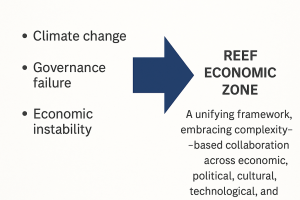
By Jelenko Dragisic and Dr Keith Noble At a recent gathering of urban and regional planning professionals, we introduced the concept of the Reef Economic Zone. As part of our session, we ran a short, informal survey designed to offer a glimpse into how this professional cohort views […]

 .ROADMENDER