Tag: complexity thinking

COMPLEXITY THINKING IS NOT A WORKPLACE SKILL

I have been thinking about this for a while and I think the motivation behind it comes from a peculiar but persistent observation.  Whenever the conversation about complexity is raised with business clients, partners or colleagues, I notice that almost immediately the discourse begins to contain it. Complexity […]

THE REEF AS SOCIETY: ONTOLOGY BEFORE ECOLOGY

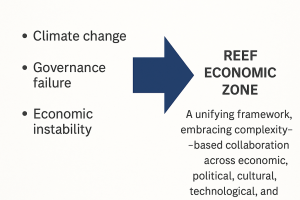
“The problem for nature is the foundation of societies which are structured with high complexity and at the same time unspecialised.” — Alfred North Whitehead, Process and Reality There are moments when language must change before anything else can. The way we speak about the Great Barrier Reef, […]

COURAGE IN THE AGE OF BEWILDERMENT

We live in an age of complexity where data alone can’t guide us. Meaning-making and the courage to trust intuition becomes essential. Courage is not only summoned; it can be created by daring to see differently. Without it, we remain bewildered. With it, even the most tangled situations can yield clarity and purpose.

HISTORY MATTERS: A COMPLEXITY VIEW OF STRATEGY

An anthropologist learns early to resist the lure of the “now” as the only reality worth studying. Cultures carry their past within them. Patterns of thought, the metaphors that shape our stories, the values that determine what we ignore and what we celebrate. These change far more slowly than market conditions. The same is true in organisations. Beneath the fresh branding and the new strategic frameworks, much of the underlying thinking is amazingly persistent. What changes most is the language in which it is dressed.

COMPLEXITY DOES NOT ARISE FROM SIMPLICITY: Towards A New Diagnostic For Complex Systems

The long-standing assumption that complexity arises from simplicity is intuitive, but possibly incorrect. Our tendency to see simple components giving rise to complex systems is shaped not by reality itself, but by the limits of our observation. A seed becomes a tree. Molecules form proteins. Words form languages. All of these give the appearance of complexity emerging from simplicity. But this is not necessarily how complexity works.

BEYOND SYSTEMS THINKING: TOWARDS A COMPLEXITY THINKING ETHIC

This piece proposes that complexity thinking is not just a methodology. It’s a moral and epistemic stance. It begins with the unsettling truth that we are not neutral observers of a system, but implicated participants. It asks us to let go of managerial comfort, inherited roles, and stakeholder entitlements and to dwell in ambiguity as a source of real possibility.