Tag: business collaboration

COURAGE IN THE AGE OF BEWILDERMENT

We live in an age of complexity where data alone can’t guide us. Meaning-making and the courage to trust intuition becomes essential. Courage is not only summoned; it can be created by daring to see differently. Without it, we remain bewildered. With it, even the most tangled situations can yield clarity and purpose.

THE COLLABORATION KILLER HIDING IN PLAIN SIGHT

We tend to think a thank you is always harmless. In teams, it might be the quietest killer of collaboration.
Why? Because in flat, peer-led projects, the person who says “Thanks everyone, great job” often does more than express gratitude — they assume the role of evaluator. Recognition flows down, not across. Without meaning to, they create hierarchy where none was intended.
Collaboration depends on fairness, psychological safety, and shared ownership. A misplaced thank you can erode all three.
Gratitude isn’t the problem, but the way we structure it is. In my latest Roadmender blog, I explore how recognition can either strengthen or sabotage collaboration, and what simple governance tools can fix it.

HISTORY MATTERS: A COMPLEXITY VIEW OF STRATEGY

An anthropologist learns early to resist the lure of the “now” as the only reality worth studying. Cultures carry their past within them. Patterns of thought, the metaphors that shape our stories, the values that determine what we ignore and what we celebrate. These change far more slowly than market conditions. The same is true in organisations. Beneath the fresh branding and the new strategic frameworks, much of the underlying thinking is amazingly persistent. What changes most is the language in which it is dressed.

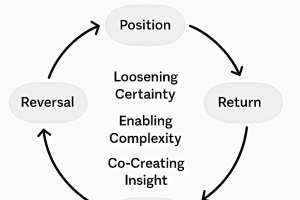
APPLYING THE OPEN SHIFT PROTOCOL TO BUSINESS COLLABORATION

This blog introduces the Open Shift Protocol—a simple yet profound method for enhancing collaborative thinking and decision-making. By encouraging individuals and teams to iteratively adopt and emotionally inhabit opposing perspectives, the method loosens rigid thought patterns and fosters deeper, more creative insight. Drawing on principles from emotional intelligence, dialectical reasoning, and creativity research, it offers a unique and structured approach to co-creation that transcends conventional brainstorming or debate, making space for innovation to emerge from complexity and discomfort.

THE GROUNDWORK MODEL: Why Strategy Begins Before It Begins

Strategy doesn’t begin with answers. It begins with orientation and orientation begins with perception. The Groundwork Model invites us to slow down and prepare the ground before acting, so that strategy becomes an emergent response to complexity not a reflex to anxiety. It’s about creating the conditions for clarity, not forcing clarity too soon.

BEYOND SYSTEMS THINKING: TOWARDS A COMPLEXITY THINKING ETHIC

This piece proposes that complexity thinking is not just a methodology. It’s a moral and epistemic stance. It begins with the unsettling truth that we are not neutral observers of a system, but implicated participants. It asks us to let go of managerial comfort, inherited roles, and stakeholder entitlements and to dwell in ambiguity as a source of real possibility.

THE HIDDEN PATH: What Quantum Tunnelling Teaches Us About Organisational Change

Organisations, like molecules, can become locked into a particular configuration. Old routines. Entrenched identities. Layers of habit that make change feel uphill. Conventional thinking tells us to overcome these barriers, kick off another reform, realign the structure, or roll out a new “change management” strategy.
But what if the most interesting changes don’t start that way?

A New Language for Climate Adaptation: Framing Climate Adaptation Beyond Linear Modelling

Climate models offer valuable scenarios, but they are still bounded by known variables and assumptions. When these scenarios are treated as definitive futures rather than possibilities, adaptation strategies risk becoming rigid and obsolete as new emergent conditions unfold. This fosters a tendency toward reactive planning, where strategies prepare for specific anticipated futures rather than a range of possible, unknowable futures.

Collaboration vs. Cooperation: Understanding the Critical Distinction

When discussing collaboration, it’s crucial to differentiate it from cooperation. While often used interchangeably, their distinctions are significant. Cooperation involves individual responsibilities, while collaboration entails a broader, interconnected approach. The mindset also differs, with cooperation focusing on individual tasks and collaboration emphasizing collective contribution and innovation, essential for workplace success and effective leadership.

Collaboration Insights

“We know that workplace productivity is linked not only to person’s skills but also to their sense of identity and esteem.” – Jelenko Dragisic, Author of ‘The Collaboration Instinct‘ Small selection of collaboration insights to help managers improve their team performance with simple culture shift towards real collaboration.

What makes collaborating teams tick?

On the surface everyone is a collaborator, and every team is a collaborating team. That is the ‘sell’ in contemporary workplaces. Businesses invest in collaboration as a part of their business strategy for a variety of reasons; improving organisational culture, trust, productivity, competitiveness or even, more imaginatively, to […]

De-risking collaboration

While collaboration has often been praised and promoted as a cure all, endorsing it in this way borders on irresponsible.  In business there are no easy, fail-safe ways of finding good business solutions to complex problems, designing winning strategies or delivering results that meet everyone’s expectations.  The appeal […]

Reclaiming collaboration

It’s time to wrest the subtle art of collaboration from the jaws of everyday spin. The famous co-founder of once widely popular start-up WeWork claimed that the majority (70%) of those who paid to use the WeWork shared space collaborated.  This always seemed like a possibility given that […]

Collaboration: newspeak, a euphemism or a real deal

We’re nearly at the 2-year mark since COVID 19 disrupted our universe.  Businesses have learnt many lessons, and many have embraced new strategies such as collaboration, even with competitors.  In fact, competitors tend to embrace collaboration with each other more often than is recognised.  This is not surprising […]

Collaboration has always been risky

A recent global collaboration study of 476 organisations found that nearly 70% have used collaboration apps.  Reliance on collaboration tools continues to increase as more companies use apps to support their business.  With that shift in workplace practice, or rather, scaling up of an existing practice, comes an […]

ROADMENDER Recommends

Collaboration has a challenging problem: it’s appealing for simple tasks but not for strategic long-term goals. The net result is that we have a market for apps and digital tools that ‘facilitate’ collaboration and implicitly lead to all the good things that collaboration produces, including increased productivity, innovation […]

ROADMENDER Recommends

The notion of collaboration as a competitive business strategy has been around for some time. In some sectors it works better than others, but the overall impact on high performing enterprises that look for every bit of advantage they can add to their competitiveness has been demonstrated many […]

How to Avoid a Collaboration Recession!

People in the contemporary workplace (read: high performing, highly motivated, competitive and resilient) expect to be given three things: meaningful work, appropriate reward and ample opportunities to collaborate. That last bit often gets neglected by executive decision makers, who in many instances ascended to those positions via old […]

Roadmender Recommends

Every now and then collaboration can be frustrating.  Invariably it gets people wondering if it is worth the effort and in particular if collaboration is really possible given that humans are prone to both competition and collaboration.  How to reconcile the drivers?  In my first book (The Collaboration […]