
There are moments when catastrophe does more than destroy buildings and lives. Occasionally it also rearranges the way we think.
One such moment occurred on the morning of 1 November 1755, when a massive earthquake struck the city of Lisbon. What was supposed to be a special day in the lives of a global power experiencing what historians call ‘Golden Age’ became perhaps most consequential event in Portugal’s history. Three tremors, lasting around eight minutes in total, were followed by a tsunami and fires that burned for weeks across what was then the fifth-largest city in Europe. The scale of death and destruction was unprecedented.
For many observers across Europe, the disaster appeared almost incomprehensible. Lisbon was a deeply religious city. The earthquake struck on All Saints’ Day, one of the most important days in the Christian liturgical calendar. The scale and timing seemed to invite theological interpretation. For centuries disasters had been explained in moral or religious terms: punishment, warning, divine will. But something unusual happened in the aftermath of Lisbon. The catastrophe triggered a profound intellectual disturbance across Europe. Philosophers, scientists and writers began asking a different kind of question.
The paradigm shift was best captured in the reframing of the expected, customary in a way, question of ‘why would God allow this to happen in what we believe to be the best of all possible worlds?’. The new question was more in line with scientific, Enlightenment era appropriate; ‘what processes could produce such an event?’.
One of the early voices was one of the greatest Enlightenment thinkers, who also gave us timeless Enlightenment motto ‘Dare to Know’, Immanuel Kant wrote several short essays attempting to explain the phenomenon. His explanations were speculative and by modern geological standards, incorrect. Kant imagined subterranean gases and vast underground caverns producing pressure within the Earth. Yet the scientific accuracy of the explanation was not the most important aspect of his work. What mattered was the shift in perspective it represented.
Kant was treating the earthquake as a natural event governed by underlying processes, rather than another moral or theological episode. In doing so he was participating in a broader intellectual transition that was beginning to unfold across Europe. Disasters were gradually being reframed not as cosmic judgements but as disturbances within natural systems. That alone is enough to argue that Kant can be seen as a kind of proto-disaster resilience thinker. While this shift in thinking may appear obvious to us today, it marked a profound transformation in how catastrophe could be understood.
The Lisbon earthquake did not simply damage a city. It destabilised an older way of thinking about disasters. In its place emerged the early foundations of what would later become hazard science, seismology and eventually modern disaster studies.
More than two and a half centuries later, our understanding of disasters has become far more sophisticated. We know vastly more about tectonic processes, climate systems and the complex interactions between human settlements and environmental forces. Yet in another sense we may be facing a different kind of conceptual difficulty. Over the past two decades one particular word has come to dominate the language of disaster policy, planning and research. Drum roll; resilience.
Communities are asked to become resilient. Infrastructure must be resilient. Economies, ecosystems, institutions and even individuals are now described through the lens of resilience. The term has spread with remarkable speed across policy documents, academic literature and development programs. In many contexts it has become almost a universal aspiration. But with that expansion something else has occurred. A side effect or sorts. The concept itself has become increasingly elastic.
Resilience is used to describe recovery, adaptation, robustness, sustainability, coping capacity, preparedness and transformation. Sometimes it refers to infrastructure strength. Sometimes to social cohesion. At other times to psychological endurance or economic flexibility. The word now carries a wide range of meanings, often simultaneously.
In practice this flexibility can be useful. It allows diverse actors to rally around a common idea. Yet there is also a risk that a concept stretched too widely begins to lose its explanatory precision. We have taken ‘it all relative’ to whole new level that at times confuses rather than clarifies. When a concept comes to mean almost everything, it can slowly begin to mean very little.
This is not unique to resilience. Many ideas that travel successfully across disciplines and institutions eventually undergo similar expansion. They become what philosophers sometimes describe as conceptually overloaded. Thus, the logic question worth asking; does the concept still help us understand the phenomena we are studying?
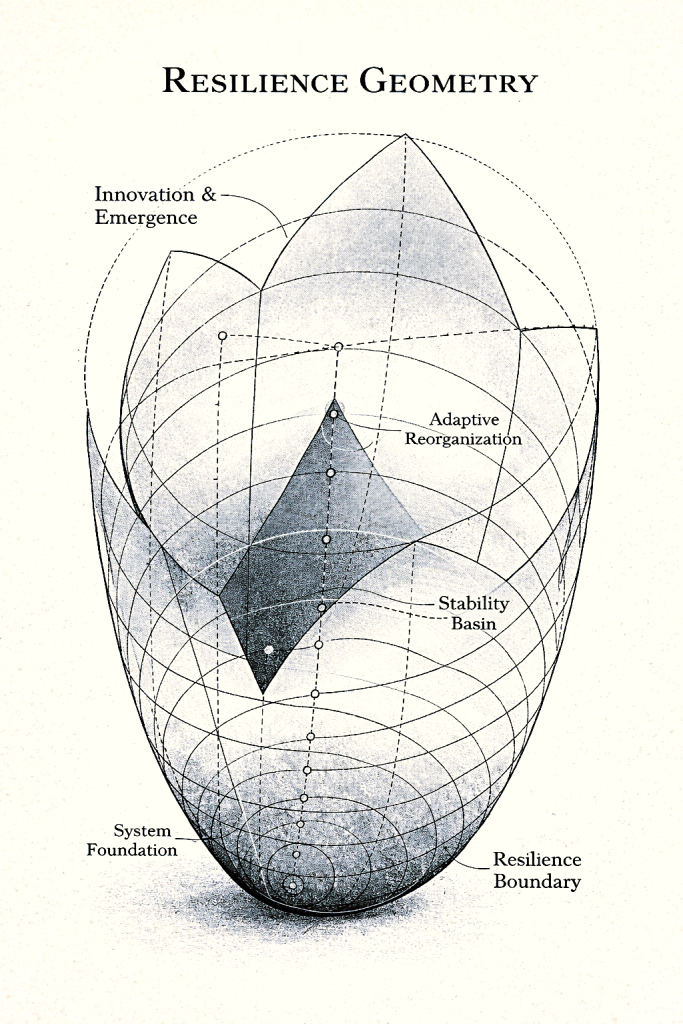
In recent years another intellectual development has been reshaping how scientists think about systems and disturbances. Complexity science, systems thinking and ecological research have revealed that many natural and social systems operate through dynamic interactions, feedback loops and adaptive processes. These systems rarely remain static. They adjust, reorganise and evolve in response to changing conditions. Disturbances are not always external shocks imposed on an otherwise stable system. Often they emerge from tensions and interactions already present within the system itself. In this context resilience cannot simply mean “bouncing back”.
A complex system rarely returns to exactly the same state it occupied before a disturbance. Instead, it may reorganise, shift trajectory or adapt in ways that maintain its overall functioning while altering its structure. Resilience, in this sense, becomes less about recovery and more about the capacity of systems to continue evolving without losing their coherence. Not only about homeostasis but perhaps more importantly about homeorhesis.
Seen from this perspective, disasters are not only destructive events. They can also reveal hidden vulnerabilities, rigidities and dependencies within systems that previously appeared stable. Disturbance acquires a diagnostic quality necessary to architecture of any system.
This raises an interesting possibility. Just as the Lisbon earthquake helped trigger a conceptual shift from moral explanations of disaster to natural processes, we may now be approaching another moment where the way we think about disasters, and resilience itself, requires reconsideration. Not because the concept of resilience is wrong. but because its current usage may no longer adequately capture the dynamics of the systems we are trying to understand.
We do not need to join the army of those who are abandoning the term. Instead, we could treat this as an invite to a deeper reflection on what the concept should actually do for us. What kind of explanatory role should resilience play? What distinctions should it help us draw? And how should it relate to the complex interactions between ecological, social and institutional systems that shape modern disasters? Concepts are not static objects. They evolve as our understanding evolves. The Lisbon earthquake forced eighteenth-century thinkers, who in fact made their living acting as closest advisers and strategist to the government and business leaders, to reconsider the nature of catastrophe itself. In doing so it opened the door to new forms of scientific inquiry.
Today the challenge may be more modest but still important. As resilience continues to spread across disciplines and policy frameworks, we may need to ask whether the concept still carries the clarity required to guide understanding and action.
If not, then the task before us is not to discard the idea but to think more carefully about how it should be used. In that sense the most valuable lesson from Lisbon may not lie in the geological event itself, but in the intellectual response it provoked. Catastrophe sometimes forces us to rebuild not only cities, but also the concepts through which we interpret the world.
Categories: Uncategorized
 .ROADMENDER