
There is no shortage of methods aimed at improving collaboration in business. From structured brainstorming sessions to agile planning boards, the array of tools and techniques is impressive. Yet, the deeper question often remains unanswered: why do some collaborative efforts deliver unexpected breakthroughs while others stall in polite disagreement or dissolve in indecision?
For some time now, I’ve been interested in the unseen dynamics that shape how we think and communicate. Both as individuals and in groups. Every decision-making process, every conversation, is not only shaped by what is said, but also by what lies beneath: our emotional dispositions, habitual perspectives, and the subtle frames through which we make sense of the world. These elements rarely announce themselves. Instead, they operate quietly, influencing the very way we collaborate.
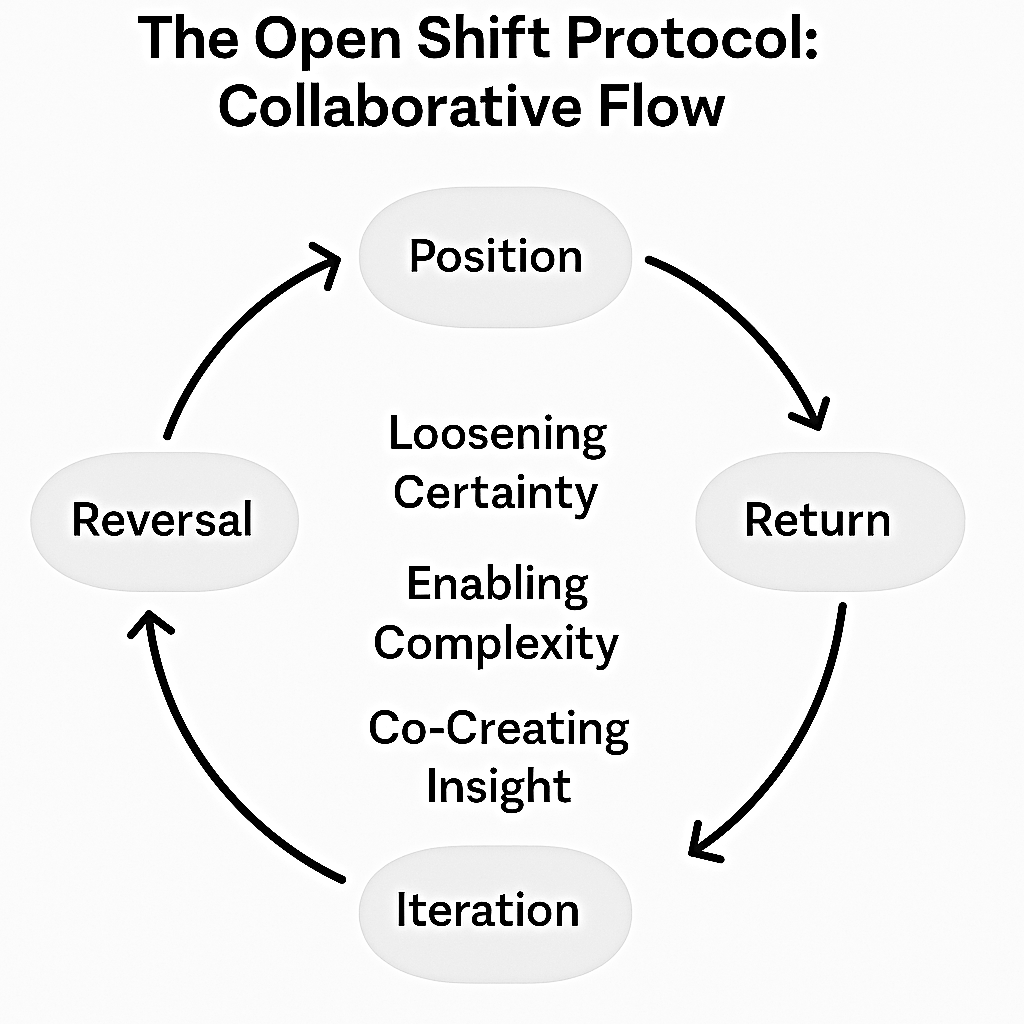
This reflection led me to articulate what I now call the Open Shift Protocol (OSP). OSP method is designed to loosen the rigid structures that often govern thinking, without abandoning the value of conviction. It is a practice of deliberate reversal, of stepping into the shoes of opposing views, not simply to ‘see the other side,’ but to feel it, to inhabit it, and then return to one’s own position with greater insight. What makes OSP distinct is not just this reversal, but its iterative movement between positions, where participants are encouraged to stay open, suspended in uncertainty just long enough for something deeper to surface.
The Open Shift Protocol isn’t about being indecisive or argumentative. Nor is it about generating consensus through compromise. Rather, it encourages a kind if discomfort, a kind that can bring latent ideas to the surface.
There is growing evidence in creativity research to suggest that our more imaginative, even slightly oddball, ideas emerge after we pass through initial waves of certainty and comfort. In business teams, this often means we need to let go of the habit of backing “our idea” and instead engage in a kind of structured ambivalence, where thinking is deliberately unsettled to make space for something new to emerge.
In this sense, collaboration becomes more than a process of mutual exchange. It becomes an act of co-creation. And co-creation requires a degree of psychological risk.
One way I often describe this approach is through a simple analogy: effective collaboration is not about backing your horse but backing the winning horse. That winning horse may not be yours, but through the Open Shift Protocol, you increase the chances of identifying it.
In a world where speed and certainty are often overvalued, the capacity to pause, reverse, and re-enter a thought with new perspective is a strategic advantage.
Here is a brief overview of how the process works. Begin by clearly articulating a position on a given challenge or idea, one that you feel strongly about. Deliberately reverse roles or perspectives. Argue for the opposing view, and more importantly, feel its emotional logic. Don’t just intellectualise it. Return to your original position and re-express it with a fuller understanding of its strengths and blind spots. And then comes the fun part; repeat this shift iteratively, ideally as a group. Ideas are passed around, embodied, tested, and reshaped, without the need to defend them. Observe what remains after the shifts. What ideas gain resonance? What loses its grip?
What makes this method particularly effective in collaborative settings is that it removes the need for egoic defence. The room becomes safer. Safeer not because everyone agrees, but because disagreement is not threatening. It becomes part of the texture of shared thinking.
The Open Shift Protocol doesn’t offer a script. It offers a rhythm. A kid of rhythm that allows groups to move between perspectives, emotional defensiveness, and intellectual commitments in such a way that complexity is not flattened but held. From this, a new insight, a more resonant direction, often emerges.
In a world where speed and certainty are often overvalued, the capacity to pause, reverse, and re-enter a thought with new perspective is a strategic advantage. It is also a mark of maturity in leadership and culture. There are no shortcuts. No templates that solve all problems. But there are methods that honour the creative potential of uncertainty. The Open Shift Protocol is one such method and a quiet tool for a more lucid kind of collaboration.
Categories: Uncategorized
 .ROADMENDER