
By Jelenko Dragisic and Dr Keith Noble
At a recent gathering of urban and regional planning professionals, we introduced the concept of the Reef Economic Zone. As part of our session, we ran a short, informal survey designed to offer a glimpse into how this professional cohort views the future of the Great Barrier Reef.
We share some of the responses here not as a critique, but as a mirror reflecting broader patterns in how different sectors are attempting to engage with complex regional challenges. And perhaps more importantly, we share them as a gentle provocation: not simply to think outside the box, but as we’ve come to say, to think outside the building.
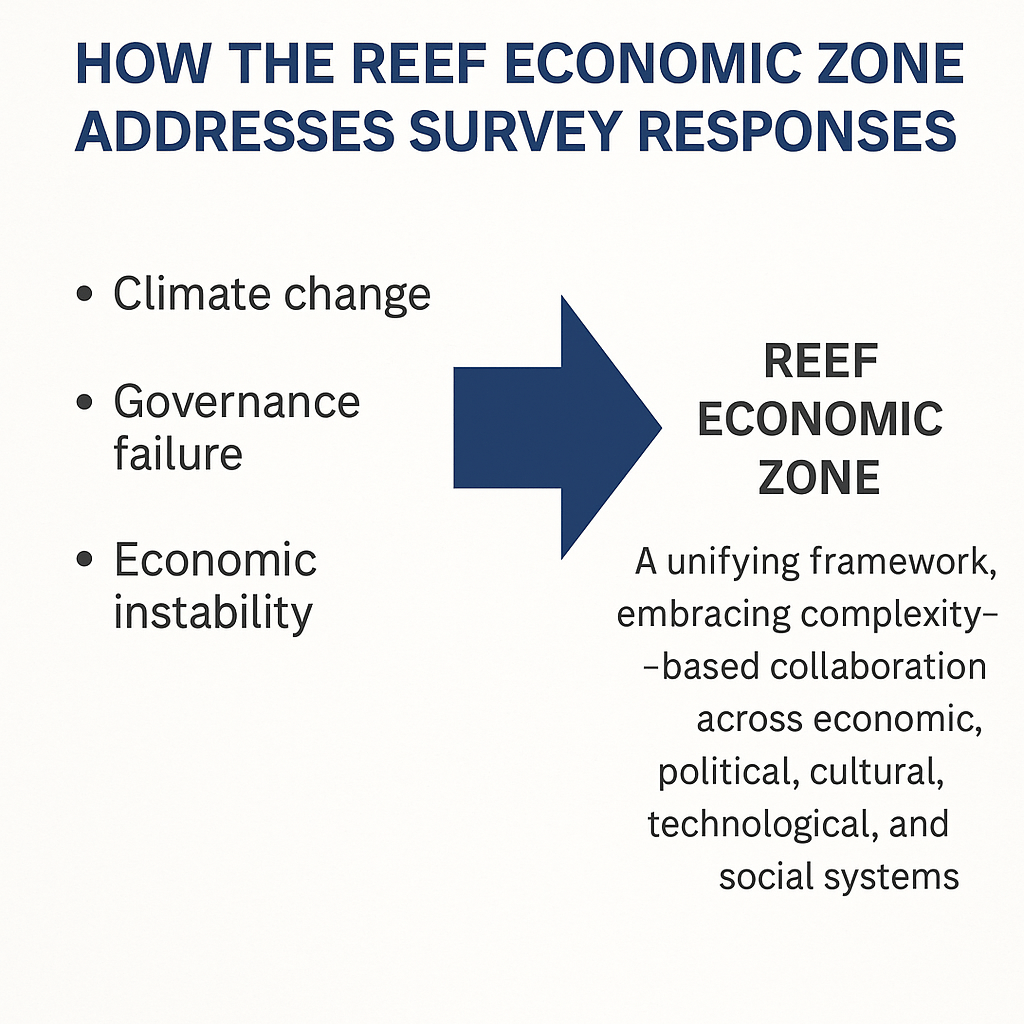
When asked to identify the most pressing threats to the Reef, 57% of respondents nominated climate change. No surprise there, given the scale and urgency of the issue. But almost as striking was the 40% who identified governance failure, alongside a notable portion who pointed to economic instability.
In a follow-up question about the key drivers shaping the Reef’s future, nearly 44% singled out government policy—placing it above even direct environmental pressures. New technologies and interventions were seen as having a more modest influence, with only 11% citing them as significant. These may be supposedly irrelevant factors (SIFs), which we believe are not being considered in a strategic manner so far.
When we sought participants’ views on what they think the Reef will look like in 2050, we noted mixed reactions. Almost half (46%) believed the Reef would look much the same. A further 40% anticipated it would be listed as “in danger” by UNESCO. A smaller but sobering group imagined there might be no Reef at all by mid-century.
When asked to rank the long-term risk factors, three in particular stood out: consumer trends in fashion and electronics topped the list, followed by tourism-related pressures and political leadership.
At first glance, these categories may seem disparate. In reality, they point to a deeper truth: the Reef is not an isolated natural system. It is enmeshed in vast and shifting global systems and paradigms—economic, political, cultural, technological, and social. Environmental science alone cannot carry the burden of saving the Reef.
This is precisely where the Reef Economic Zone idea begins. It does not claim to be a singular environmental solution. It is not a marine biology initiative. Nor is it simply a climate mitigation plan. Rather, it is a systemic proposition. One that treats the Reef as part of a complex, interdependent super-region.
Despite world-class scientific expertise and the dedication of local communities, the broader systems of governance, funding, policy, and coordination have often been fragmented, short-termist, or misaligned. In essence, we have not provided the Reef with the kind of integrated, region-wide architecture a system of a magnitude it desperately requires.
The strategy of reimagining the Reef as a system within systems does not seek to displace current efforts. Quite the opposite. It aims to strengthen them. It proposes a unifying framework that weaves together economic strategy, social development, environmental outcomes, cultural knowledge, and technological innovation. It acknowledges the 30+ regions that are directly or indirectly linked to the Reef and encourages collaboration on a much larger scale.
In essence, this is a paradigm realignment: one that abandons the linear thinking that pits different elements in the region against each other. Instead, we embrace complexity-based collaboration as the way forward. There is little value in debating the order of priorities when we clearly recognise that the Great Barrier Reef region is one household.
There is a growing consensus across government, business, science, NGOs, philanthropy and community: it’s not merely that more needs to be done—something different needs to be considered, however uncomfortable that may seem in light of all the effort made over the past decade or so.
We will be speaking more about the Reef Economic Zone at the upcoming Circular Economy Summit in Townsville this May, along with a series of regional engagements and dialogues. We’ll continue to share what we’re learning from grand ideas to subtle insights as the conversation deepens.
But for now, we leave you with this reflection: Thinking outside the box is no longer enough. The box itself with its institutional habits, outdated paradigms, rigid silos, and narrow timeframes may no longer serve us.
It’s time to think outside the building.
Categories: Uncategorized
 .ROADMENDER