
See the whole. Address what matters.
Roadmender brings senior general management experience and a whole-of-organisation perspective to consequential problems, initiatives and transitions.
The work begins by understanding what is really happening, preserving what carries value and helping the response work in practice.
Roadmender at a glance
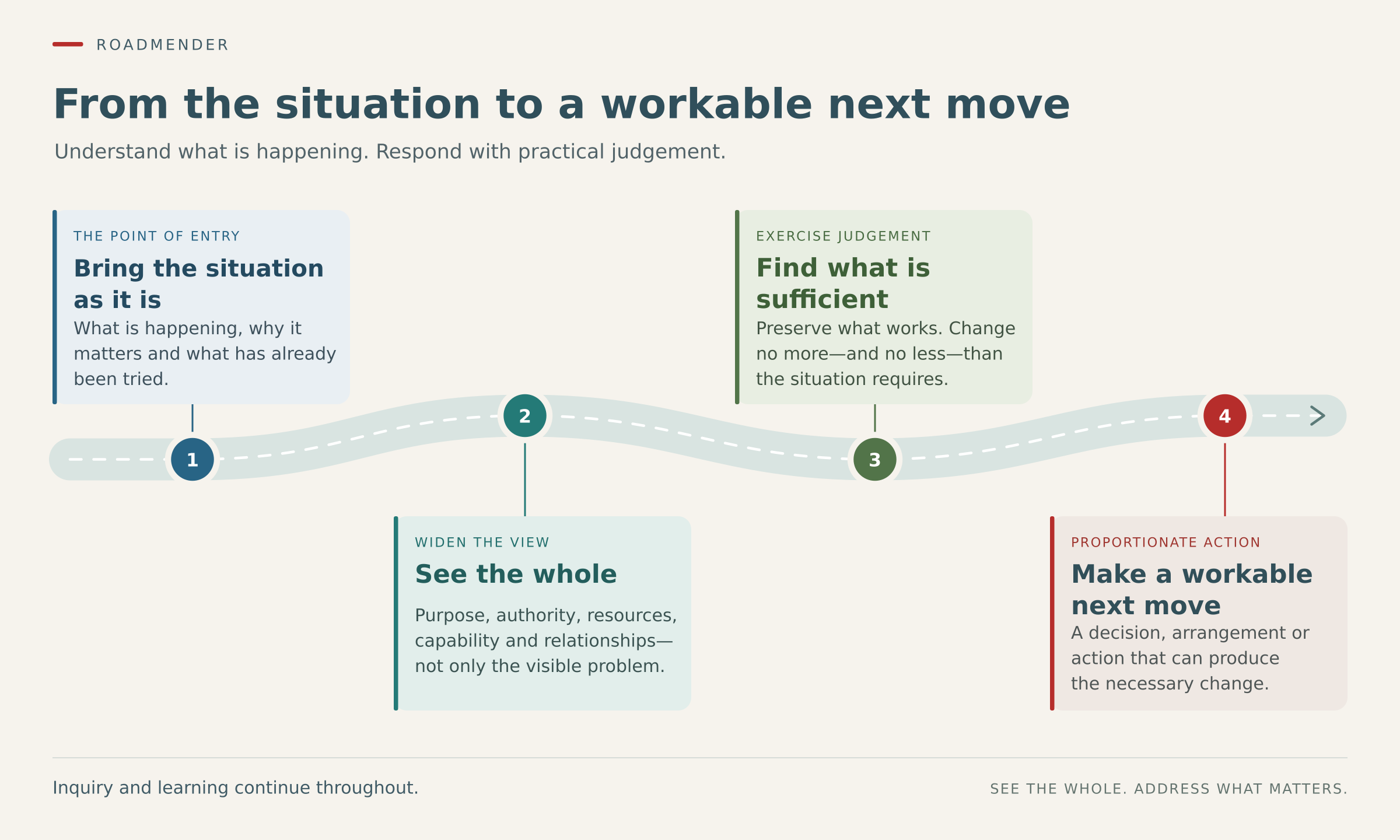
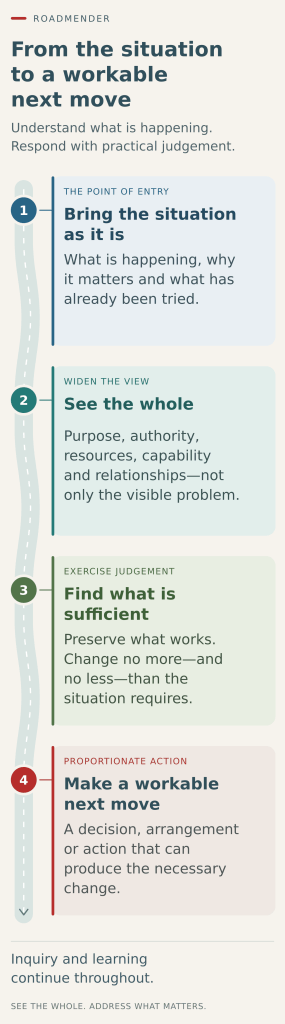
The problem may not sit where it first appears
When sensible attempts produce only temporary improvement, the problem may not belong to any one part of the organisation.
A stalled initiative, strained relationship, recurring operational issue or missed opportunity may be where wider organisational conditions first become visible.
Acting on the visible symptom alone can create activity without resolving what matters. Roadmender helps leaders understand the situation in context before deciding what should change.
Understand before disturbing
Organisations are not blank sheets. They carry history, capability, relationships, commitments and ways of working that may still hold considerable value.
Roadmending starts with the stated situation, not a complete diagnosis. It moves between the whole and the parts—close enough to understand what is happening and broad enough to see what else is materially involved.
The aim is not change for its own sake. It is to address what genuinely needs attention, preserve what carries value and leave the organisation better able to carry the work forward.
Explore the Roadmender practice →
Three practice lenses
The Whole in
View
Keep the organisation, its purpose and its changing environment in view while working on the issue at hand.
Intelligent Roadmending
Understand before disturbing. Preserve what carries value. Intervene with proportion and practical judgement.
Mission in
Motion
Connect purpose, authority, resources, capabilities and relationships so that intent can become sustained action.
What this makes possible
- Understand what is really happening.
- Make the response work organisationally.
- Build the capability to carry it forward.
When the usual answer is not enough
Roadmender is most useful when the issue is consequential, crosses organisational boundaries or cannot be fully understood or resolved within any one function or discipline.
Consequential issues
- A decision, transition or recurring problem has consequences beyond where it first appears.
- Leaders sense that the prevailing explanation—or the proposed response—does not quite hold.
Organisational friction
- Strategy has not translated into traction.
- A major initiative lacks the mandate, platform, resources, capabilities or relationships it needs.
- Credible specialist answers do not add up to a workable organisational response.
Unrealised opportunity
- Good work, capability or results are not being built upon.
- A promising partnership lacks the collective capability to realise its potential.
- An opportunity the organisation is well placed to pursue is being missed, delayed or squandered.
These are signals, not a checklist. The useful starting point is the situation as you are experiencing it.
Use what the situation requires Nothing more and nothing less
Roadmender offers four distinct ways of working. Each is complete in its own right; the choice is shaped by the situation, not by a prescribed consulting sequence.
Roadmender Perspective
A focused senior perspective on a consequential question, decision or emerging concern.
Useful when you need to clarify the situation, test the prevailing logic or identify the questions that deserve attention.
The Friendly Outside View
An independent perspective from outside the organisation, without the distance of a conventional review.
Useful when proximity, established assumptions or functional boundaries make it difficult to see the whole clearly.
Make It Work
Practical help to turn an important initiative, response or decision into coordinated organisational action.
Useful when the direction is broadly understood, but gaps in mandate, ownership, alignment, resources, relationships or execution are preventing traction.
Roadmender Alongside
Experienced senior judgement alongside leaders as consequential work unfolds.
Useful when the situation will unfold over time and leaders need continuity, challenge and practical support while retaining ownership of the work.
Judgement formed by carrying responsibility
Roadmender is led by Jelenko Dragisic. Its judgement is grounded in senior executive and general-management responsibility across sectors, together with longstanding work in collaboration, resilience, innovation, complexity and organisational growth.
That experience matters because consequential organisational work rarely arrives as a tidy specialist brief. It requires judgement about the whole: what must be protected, what must change, what can be done now and what the organisation needs to become capable of doing next.
“Experience earns its place when it improves the quality of judgement—what we notice, what we preserve and where we choose to act.”
Jelenko Dragisic
Founder, Roadmender
Ideas that inform the practice
Roadmender is informed by sustained inquiry into collaboration, resilience, complexity and organisational life. Jelenko Dragisic develops these ideas through published work and ongoing essays that bring practical experience, research and reflection together.
The Collaboration Instinct
In The Collaboration Instinct, Jelenko examines collaboration as a deeply human practice. The book explores the instincts, relationships and conditions that enable people to work together—and why collaboration cannot be reduced to process alone.
Essays and ongoing inquiry
Jelenko writes extensively about collaboration, resilience, complexity, leadership and organisational life, often exploring connections between subjects that are usually considered separately. His essays consider how people and organisations understand difficult situations and act under complex conditions.
For new and selected writing, visit Collab Notes on Substack.
Start with the situation as you see it
You do not need a finished brief or a predetermined solution. A useful first conversation can begin with what is happening, why it matters and what has already been tried.

