
A whole-of-organisation practice for consequential work
Roadmender helps leaders understand what is really happening, shape a response that works across the organisation and build the capability needed to carry the work forward.
The practice is grounded in organisational wholeness: the discipline of keeping the organisation, its purpose and its changing environment in view while attending to a specific issue.
The whole can disappear when attention turns to the parts
Organisations depend on specialist functions, professional knowledge and clear areas of responsibility. Specialists each bring a necessary perspective, but no single perspective can adequately explain the organisation as a whole.
A consequential situation may become visible within one function even though the conditions producing it are distributed across the organisation. A technically sound answer can improve the visible part while leaving authority, relationships, resources or wider operating conditions untouched.
The Roadmender practice moves between the whole and its relevant parts: close enough to understand the detail, broad enough to see the relationships around it and practical enough to identify what can be done.
Three lenses, one integrated practice
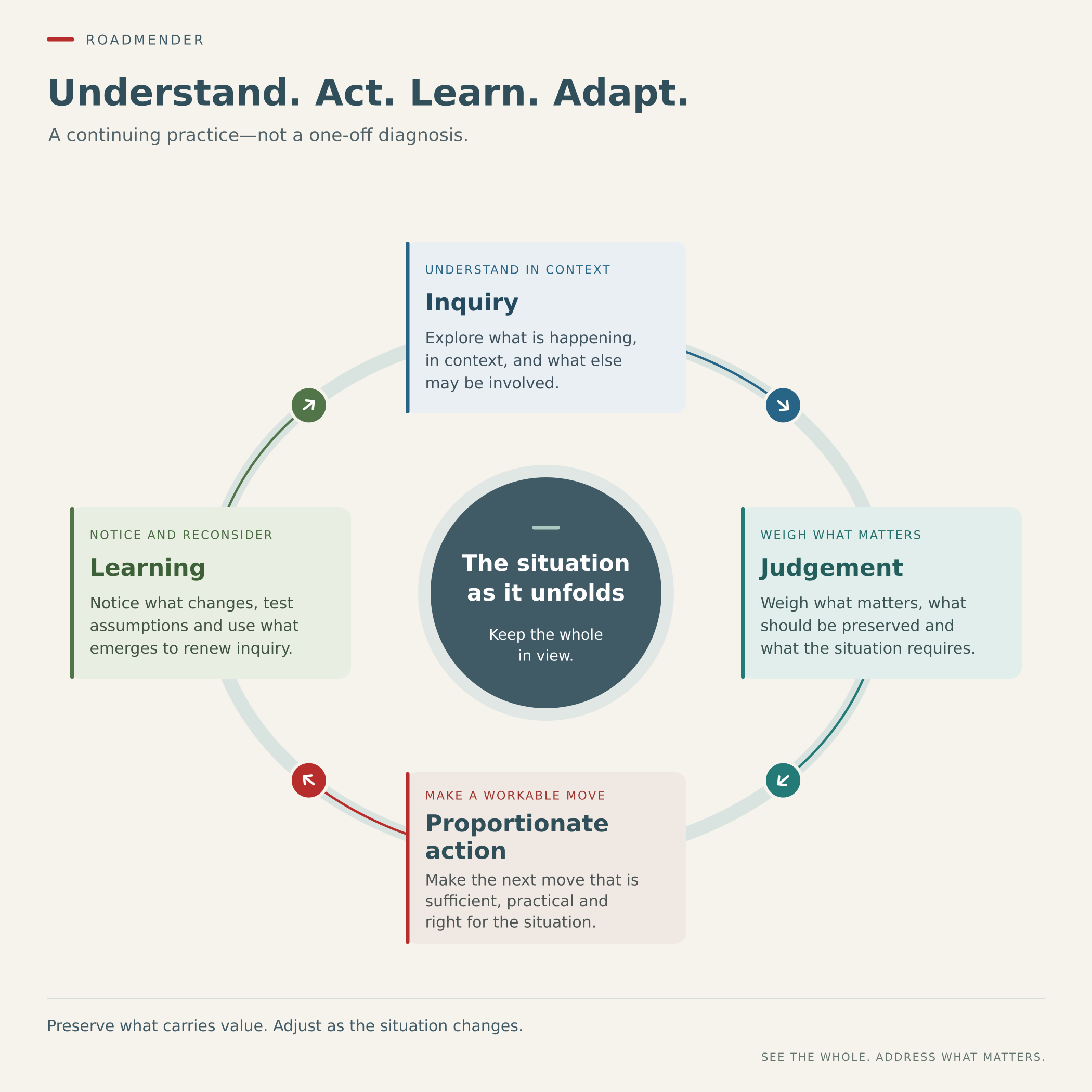
The lenses are complementary ways of seeing and working. They are not a fixed sequence; their relative emphasis changes with the situation.
The Whole in View
Keep the organisation, its purpose, relationships, history and changing environment visible while working on the issue at hand. This prevents the inquiry from becoming either too narrow or unnecessarily broad.
Intelligent Roadmending
Understand before disturbing. Preserve what carries value, locate the conditions that matter and intervene proportionately. Change is not inherently useful; the question is what to repair, strengthen, connect, release or protect.
Mission in Motion
Connect purpose, authority, resources, capabilities and relationships so that intent becomes sustained organisational action. The test is not whether an initiative exists, but whether the organisation can reliably do what its mission requires.
A recognisable pattern, not a rigid method
Organisational inquiry rarely progresses neatly from one completed stage to the next. New information can change an earlier interpretation, and action can reveal conditions that analysis alone could not make visible. The work therefore moves forward, backward and across the organisation as understanding develops.
01 Enter through the stated situation
Begin with the problem, risk, opportunity or ambition that has become visible. Take it seriously, while recognising that its first description may reflect the perspective of the person or function from which it is seen.
02 Learn the lived organisation
Use formal evidence and everyday experience together. Strategies, data, structures and contracts matter, as do language, routines, relationships and workarounds. Attend to the difference between how work is described and how it is accomplished.
03 Establish a shared grammar
Make the reasoning accessible so participants can test interpretations and contribute their own knowledge. Mandate, platform and resources offer a useful starting language without reducing the organisation to three boxes.
04 Move between the whole and the parts
Follow the relationships that materially shape the situation across functions, professions or institutions. The aim is not to enlarge every assignment, but to frame the situation at the level it requires.
05 Shape and test a proportionate response
Develop working explanations, test them with people and evidence, and identify both points of leverage and necessary continuity. Select methods because they serve the situation, not because they belong to a standard package.
06 Act, learn and leave capability behind
Treat implementation as a continuation of inquiry. Observe how the organisation uses and adapts the response, adjust where necessary and leave behind stronger conditions, useful language and greater capability for self-directed action.
Make the organisational conditions discussable
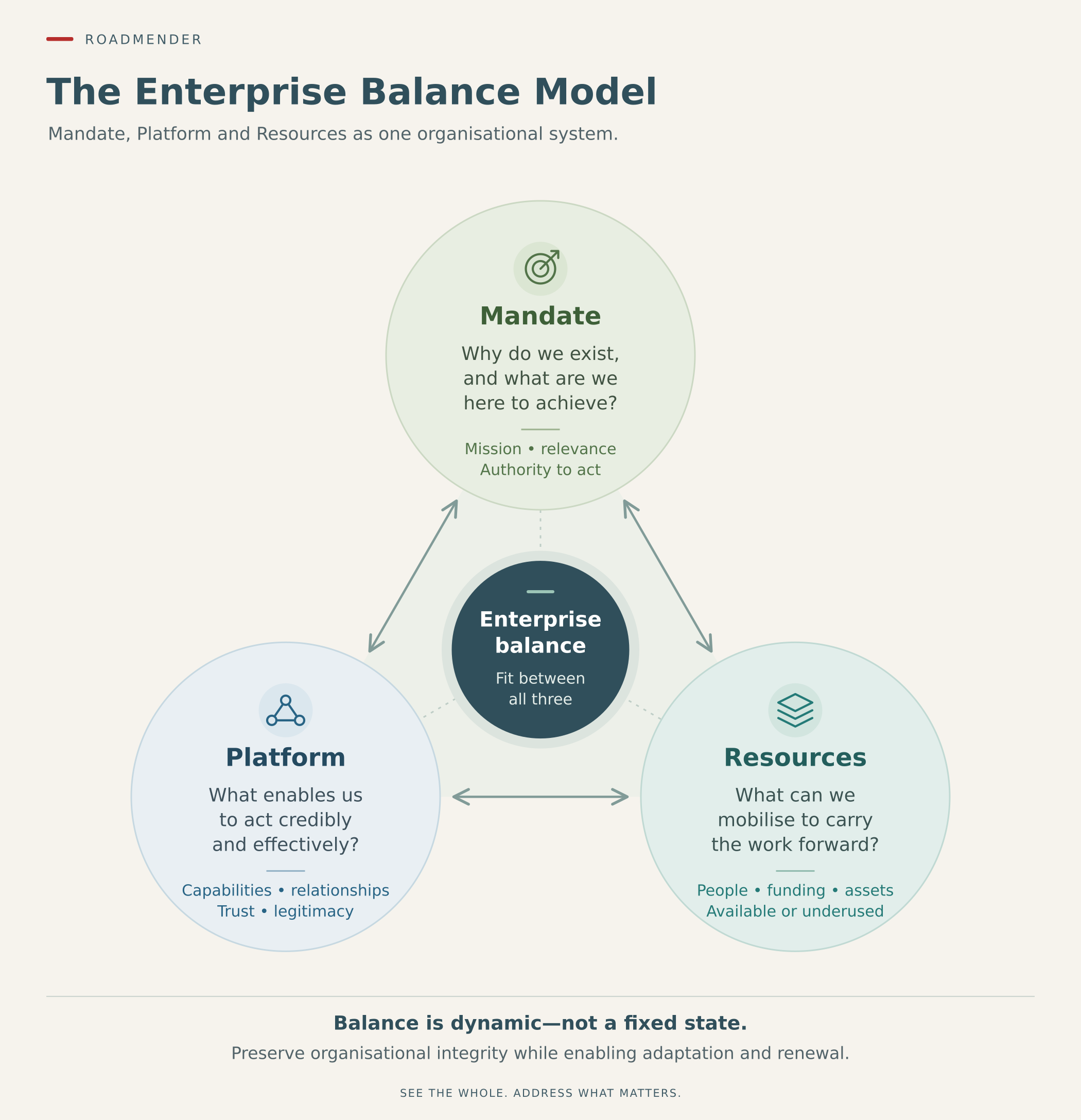
The Roadmender Enterprise Balance Model is a central diagnostic logic within the practice. It examines how mandate, platform and resources relate to one another and to what the organisation is trying to achieve.
Mandate
The legitimacy, authority, purpose and permission required to act. This includes sponsorship, decision rights, shared commitment and clarity about what the work is intended to achieve.
Platform
The organisational environment that makes the work possible: structures, governance, relationships, processes, culture, systems and a workable organisational home.
Resources
The people, time, knowledge, finance, technology, relationships, reputation and other assets available to the work—and whether they can actually be accessed, combined and mobilised.
Balance does not mean that the three elements must be equal. It describes a dynamic relationship. Additional resources may create little value when authority remains unclear; a strong mandate may create frustration when the platform cannot support it; and a sound platform may remain dormant without the resources and capability needed to activate it.
Close enough to understand Independent enough to notice
Roadmender enters as a friendly outsider: close enough to understand the organisation as it is lived, yet independent enough to notice assumptions, patterns and contradictions that may have become normal.
The orientation is curiosity before judgement, independence without detachment and proximity without absorption. People within the organisation possess knowledge no outsider can replace. Independent judgement helps connect that knowledge with observations that may be difficult to make from within.
More than a completed deliverable
Reports, strategies, frameworks and events can be useful outputs. The stronger test is whether the organisation is better able to understand its situation, make legitimate decisions, mobilise relevant capabilities and continue the work.
- A clearer shared account of what is actually happening.
- Stronger conditions for decisions, coordination and action.
- Capabilities and resources that can be combined more effectively.
- Useful language, relationships and learning that remain with the organisation.
The defining standard is simple: leave the organisation more capable than it was before.
What the practice does not assume
- Organisational wholeness does not mean the whole can be known completely.
- Keeping the whole in view does not turn every assignment into an organisation-wide review.
- Roadmending does not diminish the value of specialist knowledge; it locates and connects it within the wider situation.
- Enterprise Balance Model is not a measure of organisational maturity, a universal formula or a substitute for judgement.
- Roadmending does not promise to remove uncertainty. It helps an organisation act more intelligently within it.
Begin with what is happening
You do not need to diagnose the organisation in advance. A useful first conversation can begin with what is happening, why it matters and what has already been tried.

