
When the visible problem is not the whole problem
Roadmender is most useful when a consequential issue keeps resisting sensible attempts to resolve it—or when its causes and consequences extend beyond the function, discipline or organisation in which it first appears.
You do not need to diagnose the wider conditions in advance. Begin with what is happening, why it matters and what has already been tried. The first task is to determine whether the issue is self-contained or a sign of something larger.
One issue can reveal wider organisational conditions
A stalled initiative, recurring operational problem, strained relationship or missed opportunity may be the point at which a wider condition becomes visible. The task is not to make every problem bigger, but to identify which organisational conditions are materially involved and frame the response at the right level.
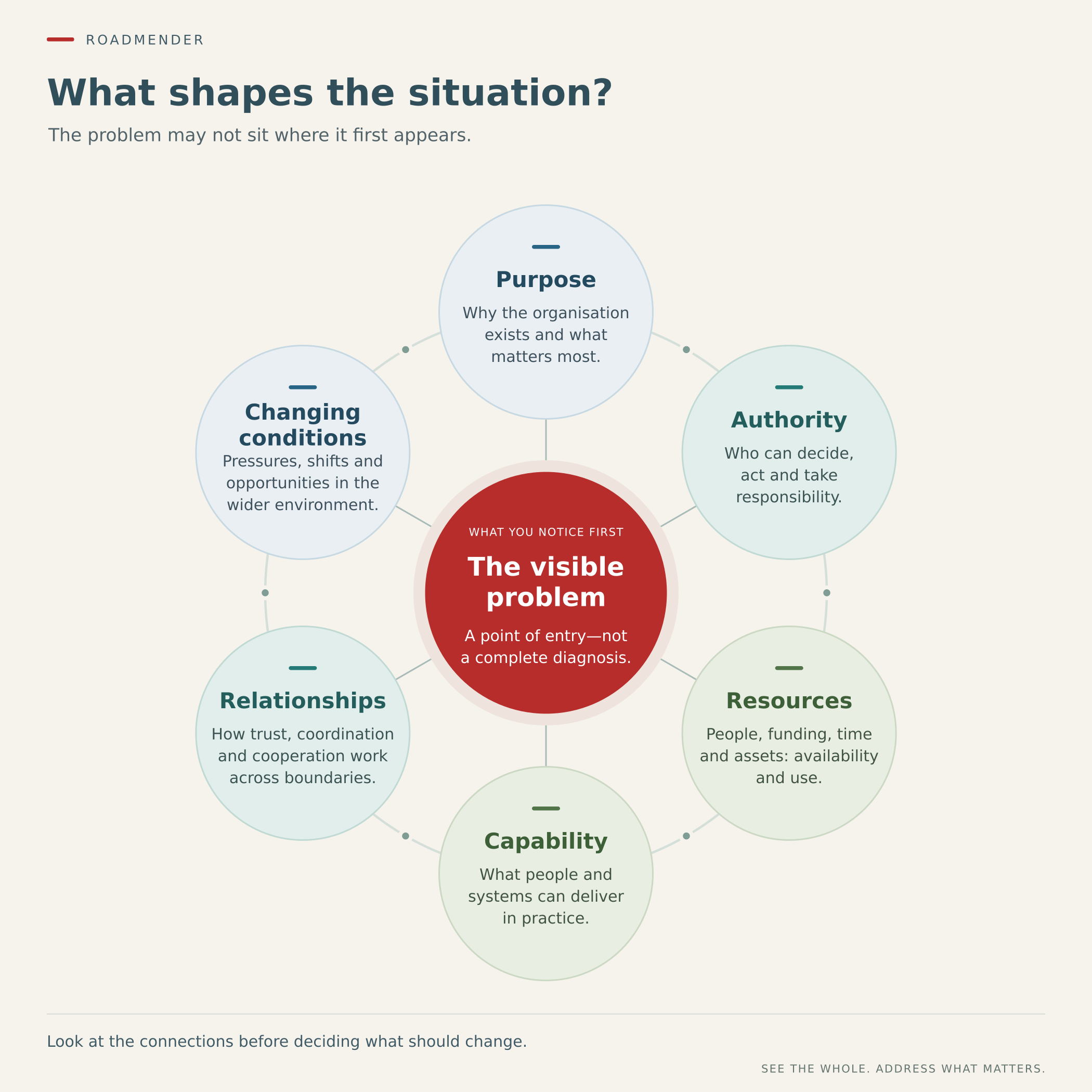
Something important is no longer holding together
The organisation is still functioning, and individual teams or functions may be performing well. Yet their combined efforts no longer produce a coherent or dependable whole. Problems are addressed locally, only to return elsewhere in another form.
This often develops gradually as responsibilities, relationships, structures and resources fall out of alignment. No single failure explains it, but the organisation feels the consequences.
You may recognise it when:
- The same problems return despite several sensible fixes.
- Capable people are working hard, yet the organisation is still falling behind.
- Each area can explain its own position, but no shared account holds.
- Reports describe one reality while everyday experience reveals another.
We know what we want to do but cannot make it real
The organisation has a clear ambition, strategy or opportunity, but cannot turn it into a dependable organisational capability.
The idea may be compelling, formally approved and supported by capable people. Yet some combination of authority, organisational conditions, relationships and resources is missing or misaligned. Activity continues, but the intended result does not become real.
You may recognise it when:
- The strategy has been approved, but implementation has stalled.
- The initiative has launched but has not taken hold.
- The idea has broad support, but the necessary decisions cannot be made.
- The expertise and opportunity exist, but there is no workable structure for bringing them together.
The issue crosses boundaries and no one can carry it alone
The outcome depends on several functions, organisations, professions, jurisdictions or communities, yet no participant has the authority or capability to achieve it alone.
People may agree that cooperation is necessary while remaining divided by different mandates, incentives, languages, accountabilities and measures of value. Goodwill can bring people together, but it cannot by itself create the shared authority, structure and commitments needed for collective action.
You may recognise it when:
- Everyone holds part of the answer, but no one can assemble or act on the whole.
- The partnership exists on paper, but collective action does not follow.
- Stakeholders agree that the issue matters but not what should happen next.
- The work sits between organisations and repeatedly falls through the gaps.
The old way of operating no longer fits what comes next
The organisation has reached a transition. Established arrangements, assumptions or capabilities no longer fit what it is becoming—or what its environment now requires.
Those arrangements may not have failed. They may simply be unable to carry the organisation into its next stage. The task is to judge what should be preserved, repaired, released, connected or created.
You may recognise it when:
- What made the organisation successful is no longer enough for what comes next.
- The organisation has outgrown structures and ways of working designed for an earlier stage.
- The environment has changed, but the organisation’s operating assumptions have not.
- Change is necessary, but losing what still carries value would be equally damaging.
These situations often overlap, and an inquiry that begins with one may uncover another as understanding develops. They are useful starting points for a conversation, not a checklist or diagnosis.
When a longstanding issue becomes a moment for action
An underlying condition may persist for years before an event makes it impossible to ignore—or creates the authority and opportunity to address it. Roadmender is often most useful in the interval between recognition and crisis: when the organisation is ready to act but still has choices about how to respond.
- New executive or board leadership, leadership succession or changing governance expectations.
- A major funding, investment or partnership opportunity.
- Failure or delay in a significant program, contract or strategic initiative.
- Rapid growth, merger, integration or a step change in organisational scale.
- Regulatory pressure, disruption, crisis or a public commitment beyond current capability.
When Roadmender is a good fit
Roadmender is most useful when the situation matters, familiar explanations are no longer sufficient, and the organisation still has room to understand what is happening and choose how to respond.
- No single function or discipline can adequately explain or resolve the issue.
- What happens in practice no longer matches the formal arrangements.
- Useful capabilities exist but cannot yet be combined or exercised effectively.
- Several parties must contribute, but no one controls the whole.
- Change is needed without losing what still carries value.
What the work needs
Perfect conditions are not required; strengthening them may be part of the work. What matters is a credible sponsor, a usable mandate, honest access to the people, evidence and everyday realities that matter, resources proportionate to the task, and enough room to test, decide and learn.
When a specialist is the better fit
A specialist is usually the better choice when the problem is clearly bounded, its cause is reasonably understood, the required technical expertise is known, and the organisation can support and act on the solution.
Start with the situation, not a finished brief
You do not need to diagnose the situation or design the engagement in advance. Bring it as you are experiencing it. You can explore the available ways of working or begin with a conversation to determine what kind of help, if any, fits.

