
Use what the situation requires
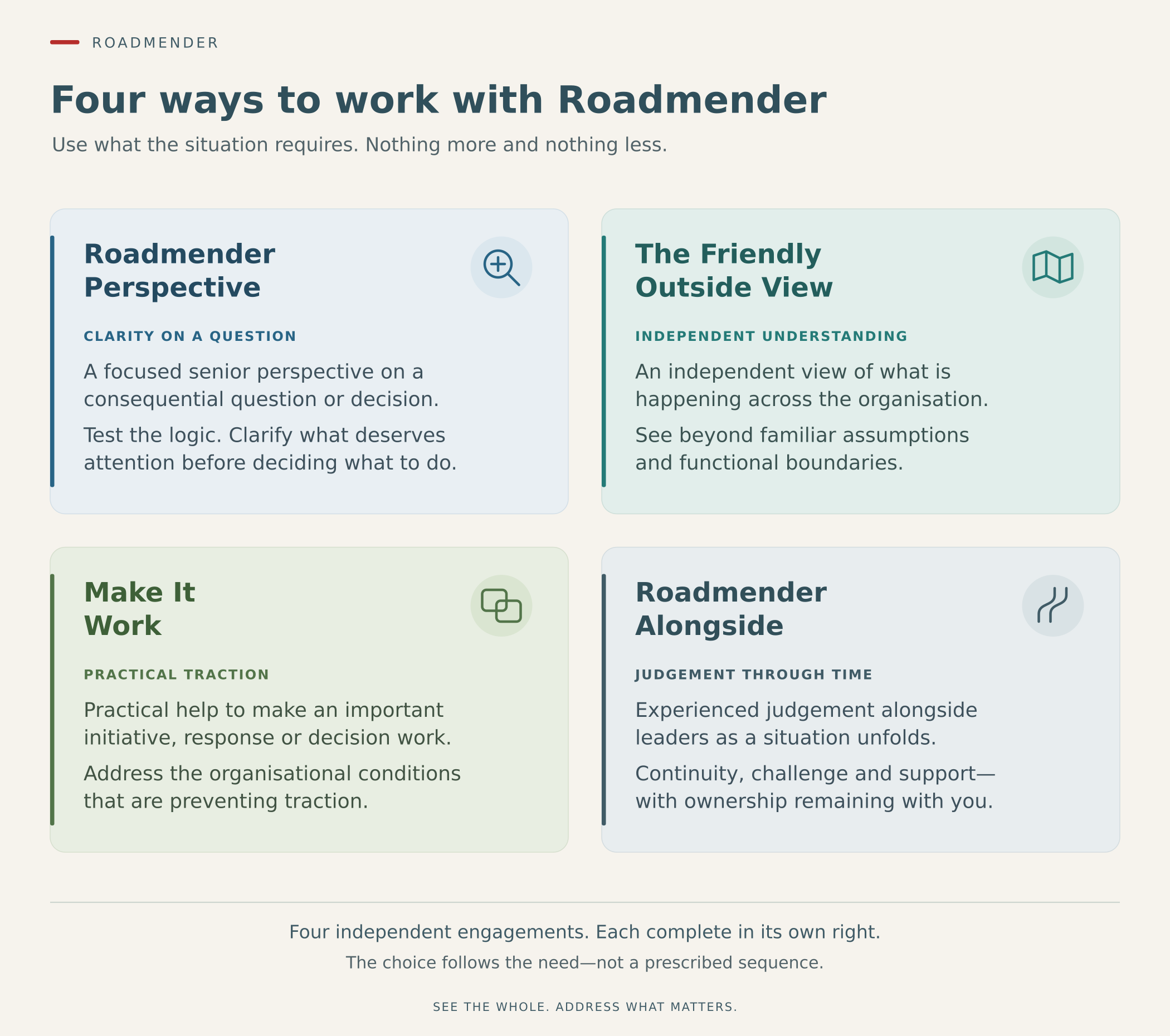
Roadmender offers four ways of working with clients. Each brings senior general management experience and a whole-of-organisation perspective, applied at the depth the situation warrants.
Each engagement stands on its own and is designed to produce a useful result. They are not hierarchical packages, and clients do not need to complete one before choosing another.
Four ways to work with Roadmender
The four engagements differ in duration, access, participation and the depth of organisational insight they can provide. A short engagement is not a lesser version of a longer one. The right choice is the one that matches what the situation requires.
Roadmender Perspective
When it fits: A consequential question or decision requires clearer thinking.
Roadmender involvement: Focused preparation followed by a concentrated strategic conversation.
Principal result: A clearer view and a more confident next move.
Typical duration: Usually completed within one working week.
The Friendly Outside View
When it fits: The organisation needs an independent understanding of what is happening.
Roadmender involvement: Low-disruption organisational fieldwork.
Principal result: A grounded situation map, findings and practical priorities.
Typical duration: Usually one to three weeks.
Make It Work
When it fits: Something important must be repaired, built, activated or reconfigured.
Roadmender involvement: Practical work with the organisation to build, repair or reconfigure what is needed.
Principal result: A workable organisational arrangement and increased capability.
Typical duration: Commonly six to sixteen weeks.
Roadmender Alongside
When it fits: Leadership needs independent judgement as a situation develops.
Roadmender involvement: Continuing strategic presence at agreed decision points.
Principal result: Coherence, adaptation and learning over time.
Typical duration: Commonly three to twelve months, reviewed at agreed intervals.
The smallest intervention capable of producing the necessary change
Roadmender seeks to understand what is already working, what is causing the difficulty and what should remain stable before introducing change. This is strategic restraint rather than resistance to change: making no more change, and no less change, than the situation requires.
In practice, four guiding questions help determine the smallest sufficient intervention: what should be preserved, what can be repaired, what needs to be reconfigured, and what must be built or replaced. They are not sequential steps; more than one may apply in the same situation.
01 Preserve
What continues to carry value?
Identify the capabilities, relationships, knowledge and arrangements that still serve the organisation’s purpose. Protect them from unnecessary disruption while other changes are made.
02 Repair
What remains useful but is no longer working well?
Restore the function of something whose underlying purpose remains sound. Recover its value before considering replacement.
03 Reconfigure
What needs to work together differently?
Change roles, relationships, sequencing, authority or resource flows so that existing parts can operate as a more coherent whole.
04 Build or replace
What does the mission genuinely require?
Create capability that is missing, or replace what can no longer be made fit for purpose. Do this only when preservation, repair or reconfiguration will not be sufficient.
Roadmender Perspective
Bring a consequential question and leave with a clearer view and a more confident next move.
A situation you may recognise
You are carrying a decision that does not fit neatly within one area of expertise. You may be considering a new initiative, responding to an emerging difficulty or preparing for an important conversation. Colleagues can tell you how the issue looks like from their part of the organisation, but you need someone who can examine the implications across the whole.
You do not need a review or a major consulting engagement. You need experienced, independent judgement focused on the question while there is still time to think. Roadmender Perspective provides that space and converts the conversation into a concise written record you can use afterwards.
Purpose
Roadmender Perspective is a focused advisory engagement for a consequential question, decision or emerging situation. It helps clarify what is being decided, test the assumptions shaping the issue, identify implications that may not yet be visible and determine a sensible next move.
When it is most useful
- A leader is considering an initiative before committing substantial time or resources.
- A decision appears simple but may have wider organisational consequences.
- A client wants to test whether a problem has been framed correctly.
- Several professional opinions are available but their implications have not been integrated.
- A difficult conversation, proposal, partnership or transition requires preparation.
- A client senses that something important is being overlooked.
How it works
- You complete a short briefing form identifying the question, relevant context and the outcome wanted from the session.
- You supply up to three essential documents, normally two to three business days before the session.
- Roadmender reviews the material and prepares the lines of inquiry that will make the conversation useful.
- A strategic conversation lasting 90 minutes to two hours examines the question, its organisational context, assumptions, consequences and available choices.
- Roadmender provides a concise Perspective Note within three business days.
What you receive
- A clearer statement of the question or decision.
- Identified assumptions, blind spots and organisational implications.
- A practical account of available choices and trade-offs.
- Recommended next moves proportionate to the situation.
- A written Perspective Note for your use.
Indicative arrangement
Typical client: Chief executive, executive, board chair, general manager, program director, partnership lead or senior project lead.
Preparation: Approximately 30 to 60 minutes, plus time to select the essential material.
Timing: Usually completed within one working week of receiving the briefing.
Commercial basis: Fixed fee agreed in advance.
Completion: The engagement concludes when the Perspective Note is delivered. Further work is optional and separately agreed.
What this engagement is not: Roadmender Perspective is not informal brain-picking, executive coaching, a substitute for legal or specialist technical advice, or a disguised sales conversation. It is a complete advisory engagement focused on one consequential question.
The Friendly Outside View
See what is happening, what is getting in the way and where useful movement can begin.
A situation you may recognise
The work is progressing, but it is becoming harder than it should be. Meetings multiply, communication breaks down, small delays recur and people begin working around the system to keep things going. No single problem appears large enough to explain the strain, yet the combined effect is consuming management attention and reducing confidence.
Alternatively, you may have secured funding, won a bid or begun a long-planned project. The team started with energy, but unforeseen dependencies and risks are appearing. Before small hassles become missed deadlines, cost increases or damaged relationships, you need an experienced outsider to examine the work where it is happening and identify what can be corrected early.
Purpose
The Friendly Outside View is a contained organisational review. It gives leaders an independent account of the situation without imposing a large diagnostic program. Roadmender looks beyond the presenting problem while keeping the agreed field of attention clear.
When it is most useful
- An important project or function is experiencing recurring friction.
- Activity is increasing without a corresponding increase in capability or results.
- The organisation has become accustomed to problems that a fresh observer may see differently.
- A team is working hard but roles, decisions, information or dependencies are not holding together.
- A new initiative needs an early health check before problems become expensive.
- Leaders suspect that the presenting problem is connected to conditions elsewhere in the organisation.
How it works
- Roadmender and the client define the field of attention, the questions to be examined and the practical limits of the review.
- You provide selected documents, identify the people closest to the work and enable observation of relevant activity where appropriate.
- Roadmender undertakes low-disruption organisational fieldwork through conversations, document review, observation and situation-following.
- Emerging interpretations are tested during the work. Useful observations do not wait for the final report.
- Roadmender identifies what should be preserved, repaired, reconfigured, built or replaced.
- The engagement concludes with a Friendly Outside View Brief and a sense-making conversation.
What you receive
- A Situation Map showing how the issue connects with the wider organisation.
- A clear account of principal frictions, blind spots, dependencies and overlooked strengths.
- A Preserve–Repair–Reconfigure–Build assessment.
- Immediate moves that can reduce avoidable difficulty or risk.
- Leadership decisions requiring attention.
- A concise Friendly Outside View Brief and final discussion of the findings.
Indicative arrangement
Typical client: Chief executive, executive sponsor, general manager, program director, board or leadership team.
Preparation: An initial scoping conversation, selected documents and practical access to relevant people and work.
Timing: Usually one to three weeks, depending on scope and access.
Commercial basis: Fixed fee for an agreed scope.
Completion: The engagement is complete with the brief and final conversation. The client may act independently using the findings.
What this engagement is not: The Friendly Outside View is not an audit, an investigation of individual performance or an automatic first phase of a larger assignment. It produces a useful independent result whether or not Roadmender is engaged again.
Make It Work
Move from knowing what should happen to creating the conditions that allow it to work.
A situation you may recognise
The organisation has a strategy, commitment or opportunity that matters, but progress depends on more than producing another plan. Roles may be unclear, authority may sit in the wrong place, partners may hold different expectations or the available resources may not be configured for the work. Everyone can agree with the intention while the initiative continues to stall.
You need practical help to repair, establish or activate the work. Roadmender joins the organisation closely enough to understand what happens when the idea encounters operating reality, then helps put the necessary arrangements in place and tests them through action.
Purpose
Make It Work is a defined project engagement to repair, build, activate or reconfigure something consequential. It is organised around an agreed organisational result rather than a prescribed volume of consulting activity.
When it is most useful
- A strategy is sound but cannot gain traction in the organisation.
- A new program, centre, partnership or enterprise needs a workable organisational home.
- A function or project requires repair rather than another review.
- Several capable parties are involved but their work has not become collective capability.
- Governance, roles, processes or resources must be configured around a new requirement.
- An initiative has reached the point where advice without practical implementation support is insufficient.
How it works
- The client and Roadmender define the result, mandate, scope, boundaries and decision authority for the engagment.
- Roadmender establishes the present conditions and identifies what should be preserved, repaired, reconfigured, built or replaced.
- The required strategic and operating architecture is developed with the people who will use and carry it.
- Changes are introduced through agreed stages rather than deferred until a final report.
- Roadmender and the organisation observe what happens in practice, learn from the response and adjust the design.
- The necessary capability, tools and working knowledge are established within the organisation before the engagement concludes.
What you may receive
- Strategic and operating architecture.
- An implementation roadmap and staged priorities.
- Clarified mandate, roles and decision rights.
- Governance and partnership arrangements.
- Redesigned processes, workflows or working practices.
- Resource and capability requirements.
- Practical tools, templates and decision frameworks.
- Early implementation support and tested adjustments.
- A Roadmender Capability Ledger recording what the organisation can now do that it could not do before; and the mandate, platform and resources that make that capability possible.
Indicative arrangement
Typical client: Chief executive, executive sponsor, general manager, board, institutional partner group or program leadership team.
Preparation: An authorised sponsor, timely access to relevant information and people, and availability for agreed decisions.
Timing: Commonly six to sixteen weeks, with scope and staging determined by the engagement.
Commercial basis: Staged or milestone-based project fee.
Completion: The engagement concludes when the agreed result and outputs have been delivered and the necessary capability established. Any extension requires a new decision.
What this engagement is not: Make It Work is not outsourced management and does not remove accountability from the organisation. Roadmender helps create and test the organisational conditions for success while authorised leaders retain decision authority and ownership.
Roadmender Alongside
Independent executive-level judgement that remains connected to the work as conditions change.
A situation you may recognise
You are leading a transition or complex initiative whose meaning will emerge over time. Early decisions will shape later options, relationships will change and apparently minor events may reveal larger patterns. A conventional report would begin ageing as soon as it was delivered, but appointing another executive is neither necessary nor appropriate.
You need an experienced independent person who can remain close enough to understand the developing situation, challenge assumptions, connect decisions across time and help leadership adjust without taking over management responsibility.
Purpose
Roadmender Alongside provides continuing independent strategic judgement during a consequential period. It gives leadership continuity of thought, pattern recognition and an outside perspective while authority and accountability remain within the organisation.
When it is most useful
- The organisation is navigating a significant transition or changing operating environment.
- A complex initiative will develop through several stages and decisions.
- Leadership needs an independent strategic sounding board with practical organisational experience.
- Several functions, organisations or partners must remain sufficiently aligned over time.
- Consequences need to be observed before the next decision is made.
- The organisation needs continuity of judgement without creating a fractional or interim executive role.
How it works
- The client and Roadmender agree the strategic field, boundaries, access, meeting rhythm and decision points where outside judgement will be most useful.
- Roadmender maintains sufficient proximity to understand the work without becoming absorbed into everyday management.
- Regular advisory conversations and participation in selected meetings maintain continuity as the situation changes.
- Short decision and interpretation notes record important patterns, choices and emerging implications.
- Periodic checks use Roadmender’s Enterprise Balance Model—mandate, platform and resources—to examine mission value, changing external conditions and whether organisational capability is moving towards or away from what the mission requires.
- The arrangement is reviewed at agreed intervals and concludes through a planned handover and exit process.
What you receive
- Scheduled strategic advisory conversations.
- Participation at selected decision points and meetings.
- Concise decision, interpretation or issue notes when useful.
- Periodic reviews using Roadmender’s Enterprise Balance Model, including checks on mission value.
- Independent identification of patterns, drift, emerging risks and new possibilities.
- A continuing record of learning and adjustment.
- A planned handover that leaves the necessary capability established within the organisation and brings the engagement to an orderly conclusion.
Indicative arrangement
Typical client: Chief executive, executive team, board chair, general manager, program executive or multi-organisation leadership group.
Preparation: An authorised sponsor, agreed access and a clear understanding of the decisions that remain with the client.
Timing: Commonly three to twelve months, reviewed at agreed intervals.
Commercial basis: Retainer or agreed allocation of days and access.
Completion: The engagement ends at the agreed review point or through the planned exit process. Renewal is a fresh decision, not an automatic continuation.
What this engagement is not: Roadmender Alongside is not a fractional executive arrangement, an interim management appointment or a substitute for internal leadership. Roadmender does not assume line authority or displace executive accountability.
The Roadmender engagement compact
The following commitments apply to every engagement, irrespective of duration or scope.
- The whole remains in view. The immediate issue is understood within the organisational system it inhabits.
- Understand before disturbing. The scale of intervention follows the evidence and the needs of the situation.
- Preserve what carries value. Existing knowledge, relationships and capability are not discarded merely because change is underway.
- Work where the work happens. Formal descriptions are considered alongside how decisions, relationships and workflows operate in practice.
- Keep interpretation visible. Roadmender shares and tests its emerging understanding rather than disappearing and returning with a verdict.
- Create useful value during the engagement. Observations are shared and improvements introduced when they can help, rather than being reserved for a final presentation.
- Connect recommendations to conditions. Advice identifies the mandate, platform and resources required for recommendations to work.
- Build capability that remains. Each engagement should strengthen what the organisation can understand and do after Roadmender leaves.
- Provide only the help required. Each engagement is complete in itself and carries no implicit expectation of further work.
Begin with the situation in your own terms
You can approach Roadmender with a defined engagement in mind or simply describe what is happening. The initial conversation establishes whether Roadmender can usefully help, which engagement best fits the need and whether the proposed scope is proportionate. There is no expectation that you will proceed.
Before work begins, you receive a written scope setting out the purpose, activities, access requirements, responsibilities, outputs, indicative timetable, fee and basis for completion. Material changes require further agreement rather than being absorbed into an open-ended assignment.

